

Fence or Canopy: Square Tube, Angle or Structural Sections
08.07.2026
For most fences and canopies the frame is built from square and rectangular tube: posts, rails and frame uprights alike. Angle and structural sections (channel, I-beam) cover specific cases where either economy or serious load-bearing capacity is needed. Below we compare the three options in practice, look at which sizes suit a fence or a canopy and show how to estimate the amount of steel before buying.
What each section is for
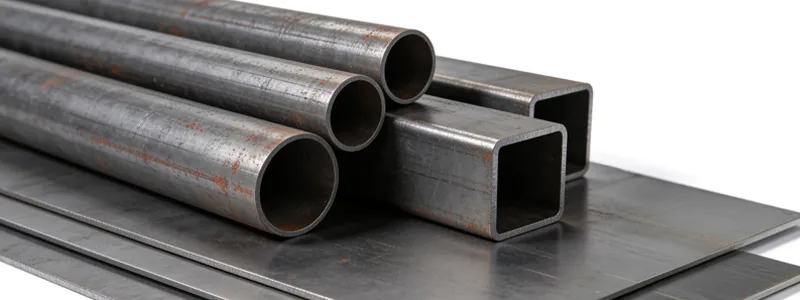
Square and rectangular tube is a closed hollow section. It carries load well at a low weight, welds and paints easily, and remains the standard choice for fences and light canopies. An entire frame can be built from it, from posts to battens.
Angle is cheaper and convenient where parts are joined by welding: panel frames, gate framing, brackets, braces. As a stand-alone post for a tall fence it loses to tube in rigidity, but it earns its keep in joints and small elements.
Channel or I-beam comes in when the load is genuinely high: load-bearing canopy beams over a wide span, supports under heavy roofing. For an ordinary fence they are excessive, but in a canopy covering several parking spaces such beams are often justified.
Fence: what to choose and how much you need
For the posts of a standard fence up to 1.8 metres high, 60×60 mm tube works well; for a tall fence or one exposed to wind, 80×80 mm. The rails that carry the infill are made from 40×20 or 40×25 mm tube. The infill material itself (corrugated sheet, metal pickets, mesh) is chosen separately and barely affects the frame calculation.
Quantities are calculated from the fence length. Posts are set at intervals of roughly 2.5 metres, so the number of posts is the fence length divided by the spacing, plus one. The height of each post includes an allowance for embedding, usually about a third of the above-ground part. Rails typically run in two rows for heights up to 1.8 metres and three rows above that; the length of each row equals the fence length. The gate and wicket are counted as a separate frame.
Canopy: frame calculation
A canopy frame consists of posts, a top frame and battens under the roofing. For a single-slope carport, posts are usually made from 80×80 mm tube, the top frame from 60×40 mm, and the battens from 40×20 mm at roughly half-metre spacing. The roofing, corrugated sheet or polycarbonate, is laid over the battens.
The wider the span and the heavier the roof, the stronger the top beam must be. Over large spans, or where snow load is significant, and in Moldova it should be taken into account, it is wiser to specify a channel or I-beam and verify the section by calculation rather than by eye. If in doubt, show the layout to a specialist before buying rather than reworking a finished frame.
A ready specification for purchase
As a reference, a typical fence 20 metres long and 1.8 metres high comes to roughly: 60×60 mm tube for 9 posts, 40×20 mm tube for two rows of rails totalling about 45 metres with a margin, plus a separate frame for the wicket and gate.
A typical single-slope canopy of 6×3 metres is approximately: 6 posts from 80×80 mm tube, a 60×40 mm frame around the perimeter and 40×20 mm battens at 0.5-metre spacing. Exact sections and quantities depend on height, wind and snow load, so the specification is worth refining for the specific site.
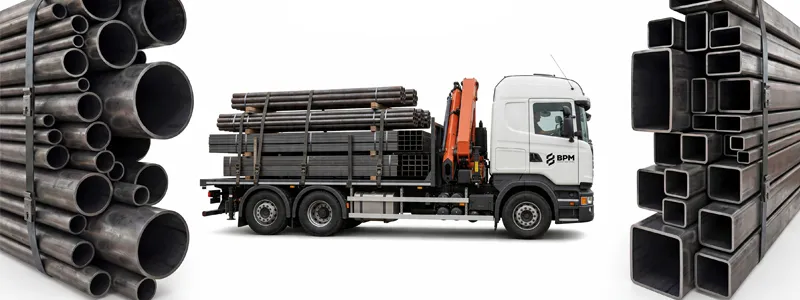
You can put the items together and calculate the weight in the order calculator on the BPM website: square tube, angle and structural sections are all in the range, and if needed the steel will be cut to length and delivered to site. Weight per metre and the full range of sections are given on the corresponding category pages.


