
Mesh
| Name | Mesh size | Diameter | Weight | Cart |
|---|---|---|---|---|
| Mesh | 100×100 mm | Ø 3 | 0,22 |
|
| Mesh | 100×100 mm | Ø 4 | 3,354 |
|
| Mesh | 150×150 mm | Ø 3 | 1,444 |
|
| Mesh | 150×150 mm | Ø 4 | 2,56 |
|
| Name | Mesh size | Diameter | Weight | Cart |
|---|---|---|---|---|
| Mesh | 100×100 mm | Ø 3 | 0,22 |
|
| Mesh | 100×100 mm | Ø 4 | 3,354 |
|
| Mesh | 150×150 mm | Ø 3 | 1,444 |
|
| Mesh | 150×150 mm | Ø 4 | 2,56 |
|
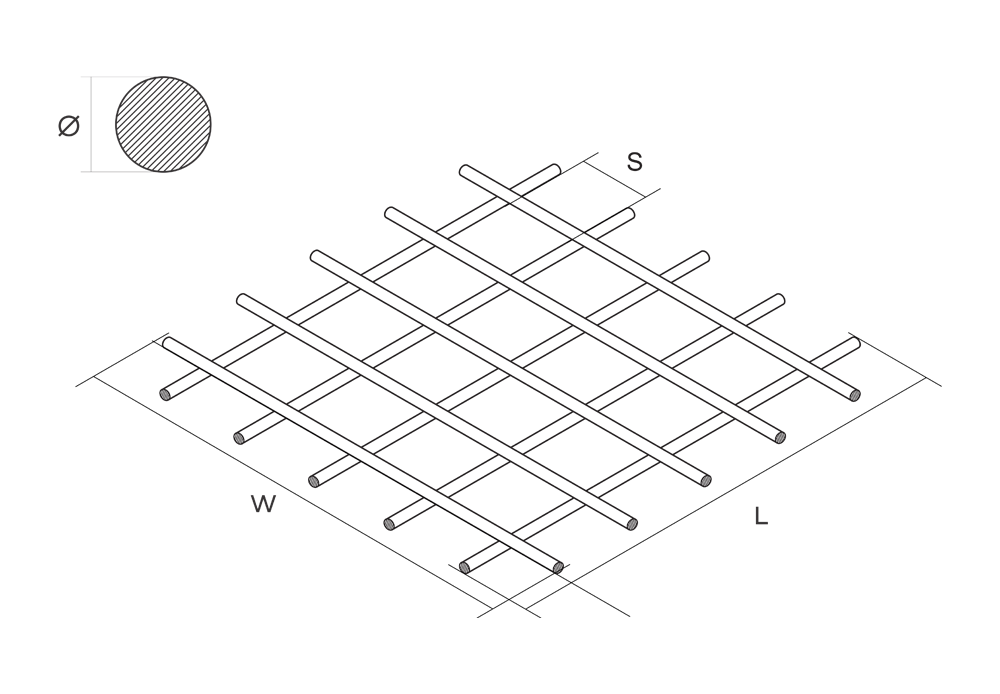
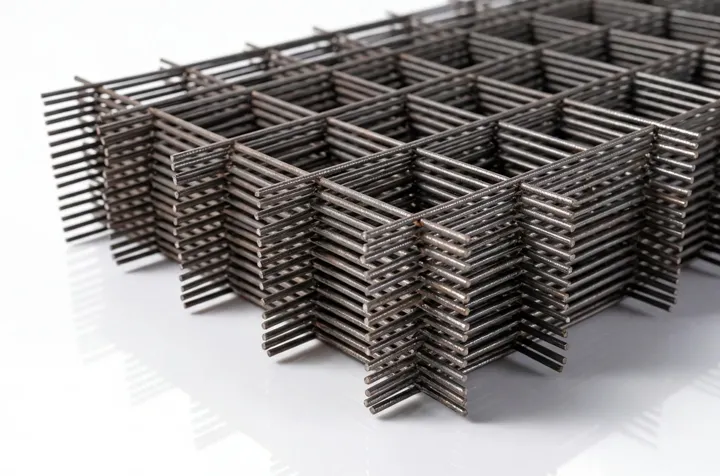
Welded mesh is manufactured from metal wire by overlaying and welding directly at the intersection points. It is produced from steel wire joined by resistance electric welding. The wire segments are arranged in mutually perpendicular directions.
The mesh pitch, the cell size varies depending on the area of application. The product is used for reinforcing brick masonry, stone walls and fences, as well as for the installation of marble and concrete slabs. The mesh serves as reinforcement, protecting the wall from deformation and additionally holding the coating in place only unlike classic heavy reinforcement structures, it is lightweight and easy to handle.
Welded mesh can be supplied in two formats:
In rolls. Roll mesh is characterized by a relatively small wire diameter, which is a necessary condition for the possibility of rolling. This type is convenient to transport and easily straightens out before use. Due to its characteristics, it has relatively low mechanical properties.
In sheets (panels). This mesh is made from thicker wire and cannot be rolled up. A sheet is a mesh characterized by comparable overall dimensions in terms of length and width.
The range of application of welded mesh is quite wide.
Construction.
Mesh is used for reinforcing building facades, swimming pool walls, and bases for heavy stone floor coverings.
Agriculture.
Mesh is used for the installation of enclosures and animal cages. Welded mesh fences are also installed to enclose fields and pastures.
Road construction.
In order to extend the service life of road surfaces and increase resistance to high mechanical loads, mesh is laid under the asphalt concrete pavement.
Installation of fencing for various purposes.
Welded mesh is most commonly used for fences enclosing garden plots.
Depending on the area of application, welded mesh can be produced from uncoated wire and from coated wire — galvanized wire.
Mesh without corrosion protection - The most affordable option. To ensure long service life, the mesh requires additional corrosion treatment, which must be repeated periodically. Standard painting is most commonly used.
Galvanized wire mesh - Zinc galvanic coating is an effective method of corrosion protection. After galvanizing, a layer of zinc resistant to mechanical impact is obtained, which reliably protects the steel from aggressive environmental exposure.
Polymer-coated mesh - Polymer coating provides very good corrosion protection for welded mesh fencing. The polymer is resistant to abrasion and can last longer than a zinc galvanic coating. In addition, polymer is more resistant to aggressive environments.
Stainless steel mesh - Based on stainless steel, this is the record holder for durability, but is also the most expensive of all welded mesh options. This is explained not only by the high cost of stainless wire, but also by the more complex welding process.
Payment options:
online by bank card;
bank transfer to current account;
cash.
Delivery is carried out:
by BPM Cement and Steel's own transport service;
to all regions of the Republic of Moldova.
BPM Cement and Steel offers:
quality products from major rolled metal manufacturers;
a wide range of rolled metal products in various sizes;
highly qualified personnel;
fast order completion and delivery to address, or pickup from metal centers;
individual approach and negotiable discounts.
1. What is welded construction mesh used for?
Welded mesh is used to reinforce concrete in floor slabs, floors and screeds. It is quick to install and helps improve the strength of the concrete.
2. What mesh sizes and wire diameters are available?
Three standard mesh sizes are available: 100×100, 150×150 and 200×200 mm. The wire diameter is usually 3 or 4 mm, while 5 mm mesh can be supplied to order.
3. What panel sizes are available?
The standard panel size is 1×2 metres and accounts for approximately 80% of market demand. Other sizes, such as 2×3 or 2×6 metres, can be manufactured to order within 5 working days.
4. How are mesh panels fastened together?
There are two main methods: tying them with wire, which is the most common option because it is quick and convenient, or fastening them with metal clips, which is used less frequently.
5. What are the advantages of steel mesh over fibre reinforcement, and what should be checked before purchase?
Steel or synthetic fibres are added directly to the concrete and may replace mesh in certain applications, but BPM does not supply such additives. When choosing steel mesh, the most important factor is the quality of the welded joints. With low-quality products, the intersections may separate, so it is advisable to purchase from a reliable supplier.


